The Times We Are In (Newsletter #2) – Preserving Authentic Content Creation
Hello again Friends and welcome to the 2nd edition of The Times We are In, a newsletter for our times by Jean-Jacques at Gypsy Cafe.
In this edition:
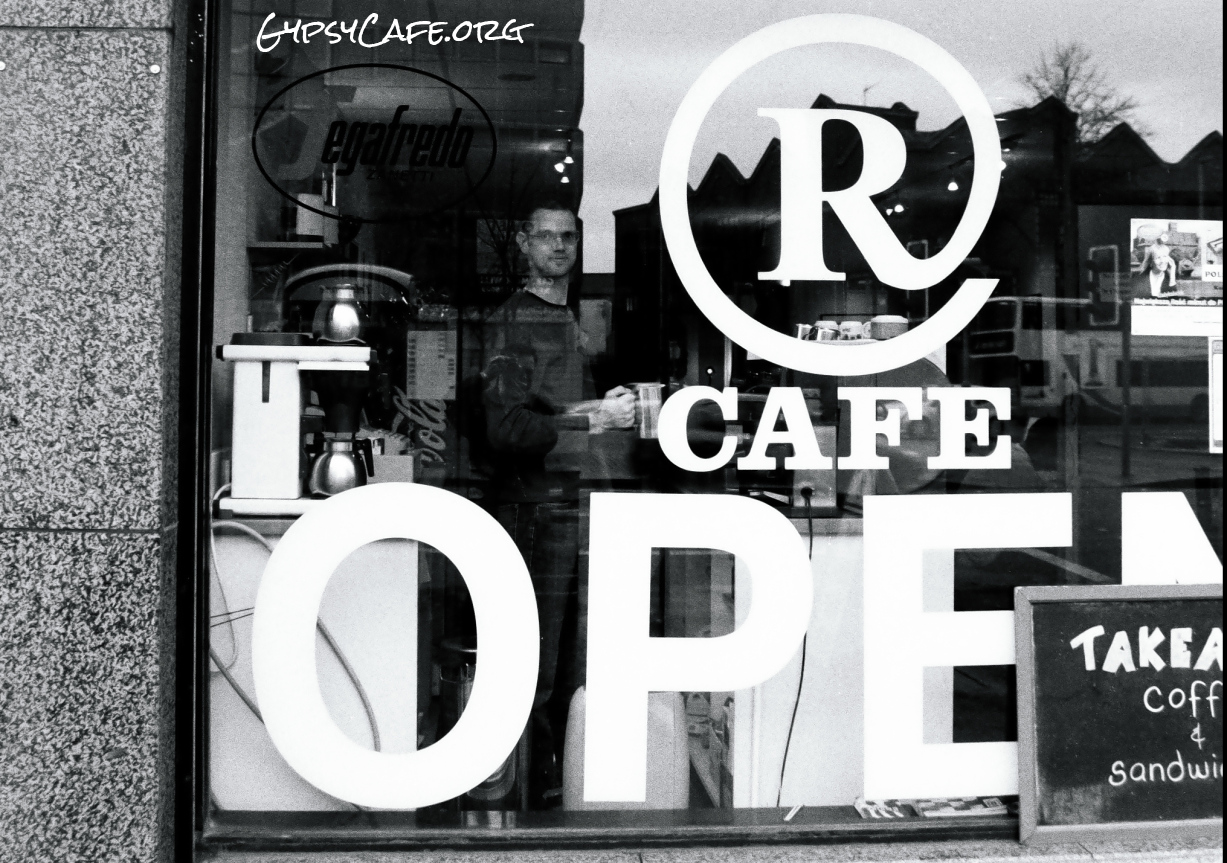
1. Cover Photo: Your writer in Belfast, Northern Ireland (2003)
2. My commitment to my readers and how this relates to the subject of A.I.
3. Piecing together past and present lives (Life Paths – Part 2)
4. Postscript: caveats, etc).
Note: Notwithstanding my measured essays, in my newsletters expect some frank opinions – ready? 🙂
My commitment to my readers and how this relates to the subject of A.I.
I recently published a Human Content Policy Statement (on WordPress.com) with regards to A.I., which relates directly to my life path and the writing paths I’m on (the policy is also available here). First, I’ll touch on my personal views on A.I. and then I’ll have a general discussion covering several points.
I believe that the content and subject matter that I present in my written work on spiritual and philosophical matters are incompatible with the concept of A.I. in general (and as a whole) because I believe that spiritual and philosophical consciousness requires clear streams by rigorous means …
Making use of A.I. in my personal life would go directly against my sense of self, which of course relates directly to my identity (yes, it goes deep 🙂 ). More on that later (in the Life Paths section), but with this briefly covered, let’s move on to the general discussion about A.I.
On the subject of A.I. generated music:
Among other genres, I often listen to jazz, Spanish guitar and classical music playlists on a popular internet video channel (you know which one) for background music while writing and when travelling. A few months ago I discovered that A.I. generated tracks, albums and playlists are often algorithmically listed first, and follow-up videos (on auto-play) are typically A.I. generated content. This meant that I inadvertently listened to A.I. music unknowingly – and after searching in the settings, it seems A.I. generated content can’t be blocked or turned off. The question is whether I would have chosen to listen to A.I. tracks if I had known it was A.I. generated? (The answer is no).
The issue for me is that A.I. generated music is almost indistinguishable from music composed and performed by humans. It is usually generic-sounding, which tends to raise my personal suspicions, but it’s hard to pick up when playing in the background. As a result I now avoid auto-play. Channel descriptions cannot be trusted because some A.I. music has “no A.I.” in their titles. My solution is to not play any music uploaded within the last 3 to 4 years. This can be time consuming to search for, so the issue having arisen is frustrating.
A further issue is how fast this type of content has proliferated. It is very possible that human created music will be completely drowned out by A.I. content soon, if it’s not already the case in some genres. How long before people just give up and settle for A.I. “slop”? (The term seems apt, doesn’t it?). Currently A.I. content is not clearly marked. Transparency on the part of content creators is apparently not demanded (certainly not by the most popular video channel). It looks like I will have to revert back to CD’s, Vinyls and cassettes again.
Now let’s think for a moment about the human effort, time and creativity it has taken (centuries of human music creation) to build up the incredible range of authentic classical, jazz, guitar, piano and other traditional genres we have available today, with some of it in the public domain (classical music especially). In many cases composers and artists dedicated their lives to their works of musical art which should be timeless and should be preserved and protected, just like we do with human artifacts that have archeological, anthropological or historical value.
Along comes A.I., and by integrating the entire historical jazz, guitar, piano, classical, (etc) catalogues on record into their memories, they can now, within minutes (apparently), produce replications that can hardly be distinguished from the real thing, even to discerning ears … Yet, those outputs are scoops from A.I.’s ‘digital soups’ … A.I. does not create anything from scratch. It delivers reproductions of mixtures of human creations that are sufficiently modified to (apparently) not be transgressing any rights as it seems to be a gray area.
I’m certain the years 2024 and 2025 will in future be considered the final years that we were relatively certain that online content (text, music and video) were mostly or mainly created by humans. This would be similar to how we nowadays watch live music concerts from the 80’s, 90’s and early 2000’s and reminisce with nostalgia about how we miss those days (!). Concert atmospheres were not contaminated by everyone sticking their Smartphones in the air back then.
Do I sound like a purist to you, friends, like a stick-in-the-mud? Am I “just getting old”? 🙂 . That’s a cliche, though. I’m Gen-X, which might mean “old” to Gen-Z and Alpha, but that’s not it. Lots of “old” people are using A.I. and loving it. But I have always been a purist on some subjects.
That all said, what are your views dear readers? Feel free to share them and to disagree!
Watch, for example, Cranberries Live in Paris 1999, to see what crowd engagement really looked like (see e.g. the free hands during the song Linger – above) without the presence of Smartphones. (The entire concert is electric in terms of the atmosphere – one of my all-time favorites!).
On the subject of A.I. in the publishing sphere:
In 2022 I self-published a book through a popular Indie book publishing platform which provides all the tools for self-publishing and distribution. However, in 2024 that platform created a huge controversy (in the site’s blog comments) among its users because it sent out an e-mail circular offering to have its customers’ books read by A.I. engines for which authors would receive royalties. The majority of writers were shocked or outraged by the idea for obvious reasons, and since then (as far as I’m aware) the issue hasn’t come up again.
Of course almost everybody basically had the same concerns – that A.I. engines would use their content to “learn to write” in the same way as they do, or better, and that in the end human writers would be crowded out by A.I “writers” on so-called Indie platforms. The fact that the idea came up in the first place stunned most authors because it was perceived as a breach of trust. The idea of having an A.I. engine train itself from one’s original content is simply incompatible with the concept of indie-writing and self-publishing in the first place. I might add that considering what has happened in the music industry of late, our concerns as self-publishers were and are entirely valid. The parallels are there.
On the subject of A.I. tools in education:
As some of you may know I work as a language coach (I teach business English as a second language to adults). The reality is that many of my students use A.I. tools in their jobs, so I’m well aware of how useful and important those tools are for them, how their tasks are simplified and how much time they save. If I worked in a different role or sector I would most probably be in their shoes.
Within the language learning sector (online) there is huge temptation for employers to implement A.I. tools and systems that would control all aspects of the teaching processes. This means that the organic human interactions between tutors and learners, which are usually spontaneous, are negatively affected and become “mechanised”.
When teachers are monitored every step of the way by A.I. ‘meeting assistants’ and ‘note takers’ which record every word and action and provide word-for-word transcripts to admin (Big Brother?), warm human interactions, creativity and spontaneity suffer. Moreover, just as in the publishing sphere, A.I. tools have the capacity to copy and learn, meaning that many teachers are nervous that they would eventually be crowded out by A.I. and virtual reality teachers. Indeed, a pattern of A.I. potentially crowding out humans in all these contexts is very evident.
With many employers in the online education sphere insisting on the use of A.I. tools, this human-oriented job sector is being turned into a “robotic sphere”. Humans are monitored by A.I. to ensure they perform ‘like robots’ while A.I. software (‘robots’) simulate humans. This development is truly dystopian in my view. Unfortunately many or most teachers simply go along with it all, making it difficult for those of us who can see the flashing warning signs to make any impact when raising our concerns.
I have to date more or less managed to navigate the situation, but not without effort and soon I won’t have a choice (or so I have been informed). Career-wise I actually transitioned from the I.T. sector into the education sector because I much preferred to work with humans rather than machines and now the machines are encroaching on everything human. Welcome to the Matrix where everybody turns into Agent Smith …
On a personal level, I just want to preserve my brain! I’m a lifelong student, writer and experiencer (see Life Paths section below), and for that I need a sharp mind. I had the same approach to social media and Smartphones when they were becoming popular (I still use them minimally) so my mindset is not something new. In fact, I already wrote about these issues back in 2016 (here and here) and initially mentioned it in 2008 (here).
On this point, I’ve noticed several articles of late about the negative cognitive impacts on people who use A.I., which support my intuitive resistance to using it. I’ll list them here for those of you who are interested – the titles alone say a lot:
Humans can no longer distinguish AI music from real music, study finds
ChatGPT May Be Eroding Critical Thinking Skills, According to a New MIT Study
Pupils in England are losing their thinking skills because of AI, survey suggests
The dawn of the post-literate society
Just a final point to consider regarding all of the above. Once A.I. has drowned out human creations comprehensively (when it has hoovered up more or less all historical and presently accessible creative human content), it will be “learning” mainly from other A.I. generated content, resulting in a downward spiral.
In short, A.I. cannot actually produce anything original – it is dependent on humans for creativity, not the other way around. It’s a shame that so many people would so easily undervalue their own intelligence and creativity, but this is clearly a strong trend, which I would ascribe to a general decline of our civilizations at the end of an era (a topic in my essays).
Wrapping up, I feel there need to be purists among us who would preserve their organically created human content by eschewing artificial intelligence, which can only really be achieved by abstaining from it. Only a purist stance will be truly effective on a personal level, in my view.
I fully respect everyone’s individual decisions on this matter, though, and I’ve given a lot of thought to the fact that I know many (probably most) of you have a lot more flexibility than I have when it comes to these issues.
Thanks for taking the time to read my comprehensive reasoning behind my Human Content Policy Statement.
Now, onto the second part of this newsletter:
Life Paths – Part 2: Piecing Together Past and Present Lives
Welcome to the second part of your writer’s autobiographical ruminations.
Naturally, I enjoy this part the most. I believe we are in an ideal time for reminiscing about our lives because of The Times We Are In.
In Part 1 I explained that every 5 or 10 years I go through an intermission of reflection, recollection and reconstitution, which would usually be followed by another round of travel. Time will tell if it will be the same pattern again (it usually is), but events in the world may affect things. In the meantime let’s enjoy the intermission.
(Warning: Some self-indulgence ahead, as is required during intermissions).
I grew up in the 70’s and the heady 80’s in a country that was undergoing events that were difficult to comprehend. My father was a radio journalist, reporter and news reader and my mother a social worker. My father initially studied theology, but during the course of his university years he decided to change track. My mother was well known for her involvement in many social projects in the communities we lived. My father had a vast library of books and magazines accessible to all of us and I was an avid reader from an early age. As a result I was exposed to a broad range of subjects.
Due to my father’s work we relocated often. That meant new towns, new schools and new friends every 2, 3 or 4 years. These family relocations and being uprooted regularly while growing up may have contributed to what would later become my long-term (or life-long) nomadic life. As a quick aside here, I believe all our experiences can have an impact on who we are and/or on who we become (see, A Man and His Bicycle, for a powerful example, considering my later interests).
This next reflection stems from a question to me by LEAFBOX on where my impulse to write originally came from (I didn’t mention this below).
It is not always easy to recall childhood events, but some may be significant and might be relevant. When I was about 8 or 9 years old I made an attempt at ‘writing a book’. I didn’t get very far, though. From some blank pages I folded together ‘a book’ and I drew a tree on the front cover with the title: “The Tree” (Very profound! 🙂 ) . I do remember being frustrated that I couldn’t go beyond that point. I really wanted to write it, but the pages remained blank. Reflecting, it was possibly an archetypal impulse, considering that I eventually did get around to publishing a book (more than 40 years later!). I wrote about important trees prior to that as well, here and here. (Who knows, perhaps there is a connection).
Just like the political situation in South Africa, my life entered a downward spiral (in many respects) after my mother passed when I was 10 years old (my father remarried within a couple of years). To be very brief, it was during the years that followed that I came to understand that that only way I could preserve my sense of self (and sanity) would be to literally escape. I became a runaway at age 17 (never to return) and by taking such a drastic action I set my life on a very unconventional path.
The nomadic grooves deepened significantly thereafter, although I think the outlines were already there. My life resembled that of a foster-child for a while (changing homes, hosts and locations) after which I had to complete 2 years of conscription (which involved several relocations). After that I was entirely on my own and had to make it in life (but I got a some lucky breaks).
To make a long story short, change featured constantly. Later I simply couldn’t get off the path of constant change into a conventional life, no matter how much I tried (and I tried). So I just kept on doing what I knew best and made the best of it (see, for example, Beyond Borders and Safer than Houses). I turned it into a way of life and a philosophy, which I termed: Travelosophy.
This philosophy can sometimes be impossible to convey to onlookers (people I meet in life). Some say that I must obviously be running away from something (from responsibilities, etc). I usually respond that I’m running towards multiple travel, work and life experiences (to get them in while I can). It could, of course, be perceived both ways – so be it … We all have to walk in our own shoes and mine are nomadic trekking boots. As far as I’m concerned I’m on a predestined Life Path.
During the mid-80’s (when I was a teenager) there was a lot of censorship in South Africa as a result of the Cold War era and the country’s apartheid laws. Media restrictions were circumvented by pirate radio stations that modeled themselves on the famous Radio Caroline (but they weren’t based off-shore). They were broadcasting from a couple of the semi-independent Homelands (known as “Bantustans” to people abroad). One of these stations was Capital Radio 604 (it relaunched as a streaming channel in 2020).
During my unhappy teenage years (around age 14/15) I was listening to 604 constantly, as we could pick it up in our area (it transmitted on medium wave). I used to endlessly search for interesting channels to listen to (also on short wave), especially late at night when I couldn’t sleep. A talk-radio station, Radio 702, was doing something similar and it provided alternative political insights on events in the country.
It was on Capital 604 that I listened to a range of up-and-coming bands from UK and Ireland, such as Cranberries, Big Country, Waterboys, Simple Minds, U2 and others. Many of these bands had political messaging in their song lyrics. During that time I became more aware of issues similar to those in South Africa in other places such as in Northern Ireland (the Troubles) and the Middle-East (which remains unresolved to this day). I understood that there were general parallels between the three situations and I hoped to understand them better one day. However, at that age it was impossible to comprehend any of it on a deeper level (including the situation in South Africa).
My exposure to alternative media and music through pirate radio as a teenager in South Africa (the country was isolated at the time due to sanctions and boycotts) laid the early seeds for my wanting to explore abroad. On the one hand I was just a young man who wanted to see the world, have some adventures (and escape from a very constrained environment, which extended to my domestic situation), but I also wanted to make sense of myself, for which I needed freedom and space.
Fast forward about a decade later and at age 26/27 I found myself in London and I truly felt the world was my oyster! I could read high quality broadsheet newspapers every day (I bought three of them daily for comparison – Guardian, Telegraph and Independent), I could regularly go to live music concerts and summer music festivals, and I could try my hand at a variety of jobs. Most importantly, I could work hard, save and travel!
I remained strongly drawn to the places where conflicts similar to those in South Africa existed as I had become even more interested in geopolitics by then. This was a couple of years after apartheid formally ended in South Africa and a ceasefire had been announced in Northern Ireland (both happened in 1994). Also, at that time there was relative peace in the Middle East (I passed through there on my way to London). In fact, it was the most peaceful time in the region in decades and there was a sense that it would be a lasting peace.
The winds of positive change were blowing everywhere and it was a very good time to be abroad. In retrospect – and I have written about it here. The 90’s was an incredible decade. I’m very grateful for having lived through it and for having lived it!
As my life path would have it, I eventually travelled to (or spent time in) all the regions and places that had parallels with, or impacts on, South Africa prior to 1994. This included Northern Ireland, Germany (Berlin Wall), the Middle East, as well as Russia and Cuba (these two latter states had major campaigns in Southern Africa during the Cold War era).
These destinations were inspired by my earlier mentioned curiosity. I knew well that one can’t believe everything the media tells you and that there is always a lot the media doesn’t tell you … I knew that the only way one can learn about complex political situations would be to take a neutral position and to suspend one’s subjectivity and biases and to hear directly from the people involved on both or all sides (if possible) as the truth is usually somewhere in the middle.
Consequently I came to some conclusions about the situations in these particular places. I was struck with some of the inconsistencies between them, notwithstanding their parallels and how they were responded to differently by the international community, (which, as an aside, became more evident as the years passed), which I reflected upon concisely here.
All of the above were prior to my heightened interest in ancient sites, ancient civilizations and archaeology, which became another chapter in my life. Again, looking back (properly), the seeds were apparently there too, because I was drawn to ancient sites (e.g the Pyramids of Giza, Loughcrew and Newgrange) from early on in my journeys, as they were informative and spiritual.
In choosing destinations more generally, I often had the approach of going to the most ‘impossible’ or ‘improbable’ or ‘far out’ destinations (literally sometimes), places which intrigued me the most from which I could learn or wanted to understand better. These types of trips always produced the most satisfying experiences.
A point I’d like to jump to which might not be evident, is that I had managed to become sufficiently autonomous, self-sufficient and self-guiding from early on with basically zero external support, to the extent that I was able to go to these places on my own steam by my own means (usually on a shoe-string). This provided a deep sense of accomplishment and it became an aspect of my identity.
Being authentic and doing everything by myself for myself was paramount – and to push my boundaries and limits even further … (in my earlier writings I ruminated a lot about this – see for example, Beyond Borders). Hence, the idea of using A.I. for anything goes against who I am on a fundamental level. This is even more so because I had to achieve my knowledge and education through a variety of alternative means.
I am mostly self-educated (an autodidact). I got some external qualifications later. I was blocked (in various ways) from following a conventional path through universities or colleges. The fact that I was obstructed from entering the formal education system strongly motivated, inspired and challenged me to learn, learn, learn (!) by my own means through experiences and self-study. I could therefore never outsource my brain to something like A.I.
Does that make any sense to you, friends? It does to me 🙂 .
I came to understand though, that if I had followed a conventional learning path I would not have written about the subjects I do write about, and I would not have had the same journey. I would not have been compelled to learn unconventionally, if I had had easy access to universities and colleges. Clearly, my life path was not meant to be conventional, and in retrospect I should thank my lucky stars considering what the formal education system churns out much of the time (no offense meant to anyone).
This newsletter has taken me about 2 weeks to put together (no research was needed) and my essays generally take anything from 2 to 5 months each due to all the reading, research, writing and refining the old-school way which can be very time consuming (fortunately I have patient readers).
Question: Could A.I. speed it all up (the research and writing processes), lighten the load and make it all easier? Surely I could then publish more regularly and complete my second book sooner?
Answer: That would degrade the experience, the process, the results, the benefits (a lot is gained through rigorous organic research) and the quality of the output. Hence, I have no interest in degrading anything.
While I understand that in my day job I could end up having no choice but to use A.I. tools (many people are in that position), as far as my personal creative work is concerned I will not take shortcuts. I will not create a situation whereby questions are raised about whether I use or used A.I. I will simply never use artificial intelligence in my creative works. In that way I will protect my integrity. This is what my Human Content Policy Statement is all about.
And on that note dear friends, this brings to a close this bumper edition of The Times We Are In. If you have read the entire newsletter I commend you and I appreciate you! 🙂 . Until next time.
Yours in Travel,
Jean-Jacques
(A previous intermission in 2014 can be read here)
[Update note: The Life Paths section is a work in progress and might be updated with additional notes, links, etc. As I’m writing from memory, I’ve updated some dates which may have been a year or two later].
Photo info: The cover photo at the top was taken at a Cafe in Belfast (N.I.) which partially inspired the name for Gypsy Café.
Postscript: Caveats, etc
We live in an age where people easily jump to conclusions or take things out of context. Since these newsletters contain autobiographical information and although what I’m about to say should be obvious, I’ll say it anyway (this is directed more at new readers). As humans we are all multidimensional beings. We go through different life stages, chapters and changes which shape our whole beings. Being from somewhere and having visited or spent time in any particular places do not define or determine the entirety of a person’s character or being. Similarly, singular moments, events or incidents do not define a person’s entire life.
Destinations or locations are sometimes ‘controversial’ due to current affairs or events of the past, or due to the views people generally hold about some places (which is what usually makes them so interesting to visit). I rarely write about the politics of South Africa (for example), not only because I’m regularly out of the country, but because its politics are still ‘trigger-worthy’ (many ideologies attached to the country’s history remain in place globally). However, it is perhaps exactly these types of destinations which should receive coverage. My next post will feature such a destination (from a tourist perspective).
© Copyright 2026. All Rights Reserved. Travelosophy.net
This is a documentary film about Capital Radio 604 which might be of interest. Although it contains some historical and political inaccuracies, it provides an interesting slice of alternative radio history and some interesting storytelling about that era, from the perspectives of those who were involved in the project.
***



6 Comments
Pingback: Just Released: The Times We Are In – Newsletter #2 (Preserving Human Content Creation) | Gypsy Café
Pingback: Human Content Policy Statement – A Commitment to My Readers | Gypsy Café
Brilliant and true, my sentiments exactly about the A.I. (and I think its future is going to turn out to be way overhyped). And it’s so skillful the way you weave in your own story. Since I’m in publishing, I’ve forwarded to colleagues, it’s what we’re facing now.
And btw, at least they forwarded you that they wanted your writing for A.I. training. There’s many examples of companies taking published works without notifying authors or obtaining their consent.
Thank you Margaret. I really appreciate your thoughts on this topic considering your work as an editor. I fully agree with you that A.I. will prove to have been majorly overhyped, it’s just a matter of time. I’ve seen articles recently saying that companies are running into all sorts of issues with A.I. with hardly any returns on their investments … (it’s proving disastrous in some cases) here’s one:
https://futurism.com/artificial-intelligence/economics-running-ai-company-disastrous
In the meantime it’s actually a major crisis. What has been unexpected is how people have fallen for A.I. generally with so little push-back. I’m not sure what we can do other than preserve our works the best we can, meaning having hard copies. I have always highly valued physical books and I often buy vintage books on auction sites, or from second hand book stores (I have a collection of books I’ve built up that I keep in storage when traveling). Hard copies are always the best, the most enduring and pure as they can’t be altered (which goes for hard copies of music too).
If this crisis motivates a percentage of readers, writers, authors and people in the publishing industry to take a purist stance (which I’m holding thumbs for), interesting communities might still form and develop from it. I’m already keeping an eye out for such developments. Hopefully the A.I. crisis will prompt people to reevaluate and revalue organic human creativity sooner rather than later.
I value your input, Margaret!
Jean-Jacques
A perfect read for me this morning, Jean-Jaques—a powerful and timely piece. Your argument that spiritual and philosophical work needs “clear streams” of consciousness, unassisted by AI, is what makes such work relatable and inspirational to readers. There is something ‘human’ that connects us to our world, and I simply don’t think this can be recreated by anything other than human emotions & rationality (including human errors). I agree and appreciate how you connect the current flood of AI content to your own life path as a self-educated, nomadic writer; it makes the stance feel lived rather than abstract. I’m seeing the same, whether in writing, but especially in photography. AI work can be good, case in point: a friend of mine sent me a song by Eddie Dalton to listen to, I enjoyed it because it sounded similar to Robert Cray, whom I grew up listening to… only to find out it was AI-generated. Shocking, but after talking with my friend, we agreed that while good, something was simply missing. I agree with you, we do need to preserve fully human processes in music, publishing, and teaching, as you have written. But in a world when shortcuts are easily available, it will become rarer, which makes the work you create that much more valuable.
And the Cranberries live, brilliant 😊. I saw them in Seattle in the late 90s… this video takes me back! Cheers to a great weekend ahead.
Glad you enjoyed it Randall. On the subject of A.I. I wanted to bring across to myself and my readers why I’m taking such a strong stance on this issue. I’ve been wanting to write about it since last year but I got caught up in my essay deadlines which demanded all my focus. If it weren’t for the A.I. issue I might not have written so comprehensively about my life path/s but at the same time I’m happy for the motivation to actually do so.
Yes, absolutely – my view is that for us as writers and readers to interact warmly and sincerely there must be a sense of human authenticity that binds us. When writers start using A.I. it compromises that sense of authenticity. On the Substack platform, for example, I actually stopped reading some writers when it became evident they were increasingly using A.I. These were normally good writers on esoteric and philosophical matters, but I just couldn’t take them seriously anymore as the quality of their output declined (and they doubled downed on using A.I., having somehow become mesmerized by it …). For me this issue really goes to the core of my credibility as a writer (which is why I simply won’t ever use A.I. as I don’t want to lose any of my readers).
Agreed regarding photography it’s complex too. With digital photography the “purism” of the art (or the dividing lines between what is ‘authentic’ and what is not), has long been blurred. Photography has always been an experimental art and even with analogue film cameras we used to use filters sometimes – and when we took out films to the studios for processing they used additional filters to enhance images.
Interesting about the Eddie Dalton song – it seems to be similar to the Breaking Rust (A.I. country band] song ‘Walk my walk’, so it seems a lot of people don’t mind if it’s A.I. as long as it sounds good …
https://engoo.com/app/daily-news/article/ai-slop-tops-us-music-chart/dJnqisPQEfCNRYckUfYIEA
So you are right about what we can expect to happen in a world of shortcuts going forward. I mean, as a result of hyper-consumerism globally people have adapted to a world of fast food, generic prepacked TV-meals and elevator music, so the A.I. craze is just the next stage … perhaps we shouldn’t be so surprised, but I always am. It just makes me more adamant to take a purist stance though.
How lucky you were to see Cranberries in Seattle! I’ve seen loads of bands but that’s the one that got away somehow. Which is why I enjoy that Paris concert so much – it blows me away every time. What a band! We are in a good time to reminisce about the good stuff of the past, which I’m planning to do some more, so watch this space 🙂
Cheers my friend – here’s to good journeys, good writing and good music!